
Cricket is a recreation full of strategy, and one of the most thrilling elements of restricted-overs cricket is the powerplay. Whether you’re a novice or an everyday viewer, the powerplay regulations in cricket can help you enjoy the game even more. In this article, we will give an explanation for powerplay in a simple, clear, and human-readable way.
What is Powerplay in Cricket?
Powerplay is a specific phase in a cricket fimatchn which fielding regulations are implemented. During this time, the fielding team is not allowed to vicinity too many players outside the 30-yard circle.
This creates a bonus for the batting team due to the fact therthat e are extra gaps in the discipline. As a result, batsmen can score runs exmoreasily, in particular barriers.
In simple terms:
Powerplay = Fewer fielders outdoor + More scoring possibilities
Powerplay Rules in ODI Cricket
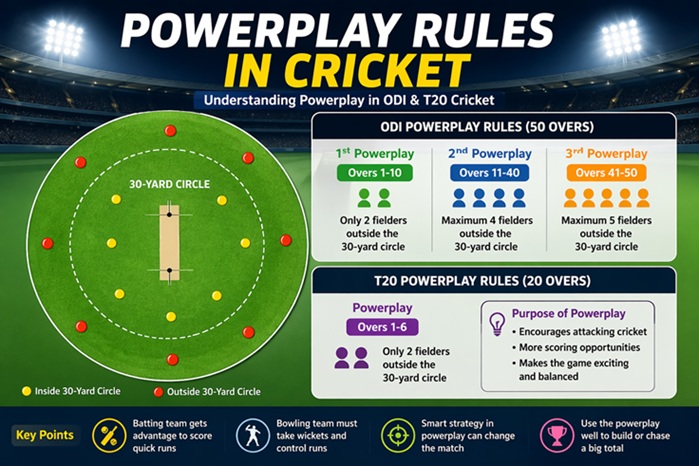
In One Day Internationals (ODIs), which might be 50-over matches, powerplay is divided into 3 stages. Each section has one-of-a-kind fielding regulations.
1. First Powerplay (Overs 1–10)
This is the beginning phase of the innings and is also referred to as the mandatory powerplay.
- Only 2 fielders are allowed outside the 30-yard circle
- Batsmen usually play attacking cricket
- Teams attempt to get a quick start
Because of fewer fielders at the boundary, openers often take risks and opt for massive pictures. A strong start on this phase can give the batting crew a massive benefit.
2. Middle Overs (Overs eleven–forty)
This is the longest segment of the innings.
- Maximum 4 fielders are allowed outdoor the circle
- Teams attention on constructing partnerships
- Strike rotation becomes very critical
In this segment, batsmen usually avoid pointless risks and recognition on singles, doubles, and occasional limitations. It is a balance between attack and defense.
3. Death Overs (Overs 41–50)
This is the very last segment of the innings.
- Maximum 5 fielders may be positioned outside the circle
- Batsmen play competitive shots
- Teams purpose for optimum runs in minimum balls
This phase is frequently known as the “death overs” due to the fact it may determine the very last score of the match. Big hitters attempt to score as many runs as viable in the previous few overs.
Powerplay Rules in T20 Cricket
T20 cricket is shorter and extra fast-paced compared to ODIs. That’s why it has most effective one powerplay phase.
Overs 1–6 (Powerplay)
- Only 2 fielders are allowed outdoor the 30-backyard circle
- Batsmen assault from the very starting
- High scoring fee is predicted
This is the most exciting part of a T20 in shape. Teams try to take complete advantage of the fielding restrictions and score as many runs as viable within the first 6 overs.
Is There Powerplay in Test Cricket?
No, Test cricket does now not have a hard and fast powerplay.
Test fits are played over 5 days, and the format is greater approximately staying power, approach, and long-term strategy. Field placements are controlled completely by way of the captain, with none fixed restrictions like in ODI or T20 cricket.
Why is Powerplay Important?
Powerplay performs a primary position in figuring out the final results of a suit.
For the Batting Team:
- Easier to hit limitations
- Opportunity for a sturdy start
- Less pressure in early overs
For the Bowling Team:
- Need to take early wickets
- Control the run drift
- Prevent batsmen from dominating
If the batting group makes use of the powerplay nicely, they could set a sturdy basis. On the other hand, if the bowling group performs nicely, they could put the batting facet underneath strain.
Smart Powerplay Strategies
Batting Strategy:
- Openers must be assured and aggressive
- Focus on finding gaps within the discipline
- Mix attacking pictures with clever strolling
Bowling Strategy:
- Use swing bowling in early overs
- Maintain tight line and period
- Set smart area placements
A right approach in the course of powerplay can exchange the whole momentum of the sport.
FAQs – Powerplay Rules in Cricket
How many fielders are allowed out of doors the circle?
- ODI: 2 (first 10 overs), 4 (middle overs), 5 (last overs)
- T20: Only 2 during the primary 6 overs
When does the powerplay arise?
- ODI: First 10 overs
- T20: First 6 overs
What is the main reason of powerplay?
The most important goal is to make the sport extra interesting through encouraging attacking cricket and better scoring.
Conclusion
Understanding the powerplay guidelines in cricket is vital for each cricket fan. It is the phase wherein the game turns into speedy, aggressive, and complete of movement.
During powerplay:
Batsmen try to rating speedy
Bowlers attempt to take early wickets
This balance between assault and manipulate makes cricket even extra interesting to watch.
If you recollect one simple rule, it is this: